
Who is ‘Yinnon’ ?
Why should this be important to you? Let us go further.
In Psalm 72 we can read:
May the kings of Tarshish (The West) and of the islands (the continents of the world) bring presents; may the kings of Sheba and Seba (Meaning present day Arab, African, Islamic lands) offer gifts.
He will spare the poor and needy, and will save the souls of the needy.
He shall redeem their soul from deceit and violence; and precious shall their blood be in his sight.
Long may he live, and may the gold of Sheba be given to him; may prayer be made for him continually; and may he daily be blessed.
May his name endure for ever; may his name be continued as long as the sun; may men also bless themselves by him; may all nations call him happy.
Are you Jewish?
To those of you born Jewish, I ask you here right now … Is HaShem so simple as to be one dimensional with you? Or … maybe there more for you to know and glean in Who HaShem is?
Are you a Christian?
To those raised for even a small time in a church and those calling themselves Christians, there is a Jesus beyond the picture considered inside your local church. Have you looked deeper?
Were you born in Islam?
For those born in Ishmael (Muslims) who had gold brought to him? What is his namel? Is Isa merely a great prophet? Or is there more to know …?
There is One right here – who loves you. Keep reading below …
Most of you have done reading through your life and are familiar with the Tanakh (Torah, Prophets, Writings) and the Brit Chadashah (known to the world as the New Testament; more accurately ‘Renewed Covenant). Yet are you acquainted with the ancient Aramaic writings known as the Targums ?
Why should I care you might ask? Simple. The Targums are about the One who is set to redeem the World.
The Vilna Gaon says that these four opinions are one since the initials of Menachem, Shilo, Yinnon, and Haninah make up the word Moshiach. The Gemara tells us that Moshe Rabenu and King Solomon had many names. Similarly the messiah has many names.
Samuel said: “There is no difference between this world and the days of the messiah except servitude to foreign kingdoms.” Rabbi Johanan said: “All the prophets prophesied only for the days of messiah, but what concerns the World to Come ‘no eye hath seen, oh God, beside Thee, what He will do for him that waiteth for Him’ (Isaiah 64:3).”
The Shema
We shall, this evening, this morning, this time right now, if you will, investigate more here this important matter of the prayer all Jewish People know and say.
It is called the – ‘Shema’
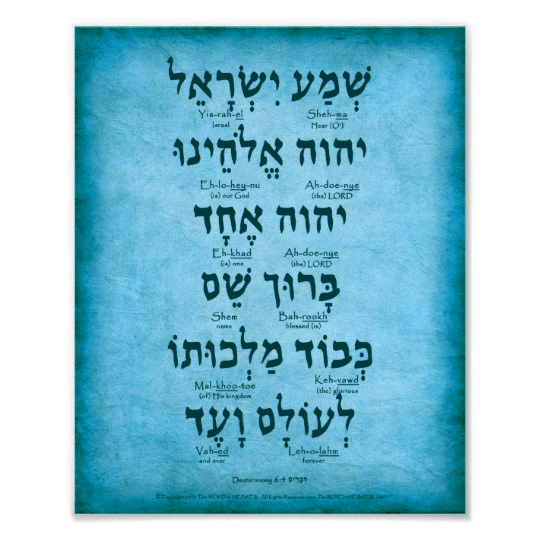
(source of art honored)
It is the prayer Jewish People all over the world pronounce, recite, at Shacharit, Minchah, Ma’Ariv, on Erev Shabbat, the Festivals and when we think death is near to us.
(“Hear O Israel ADONAI your God the ADONAI is One”)
‘Hear, Obey and Gather O Israel to the Lord your God the Lord is One’
Shema in Hebrew means to hear and is also means to obey and to gather
Consider just briefly words found in Isaiah 53 which says that: “… each one has gone his own way.”
If there has been a ‘going out‘ then there is also going to be a ‘coming back (‘a regathering‘).’
ADONAI ‘One’ or ‘Three’ ?
It is said that Adonai is ONE.
Yet there is a relationship of THREE found.
A relationship between Father and the Son and Spirit (Ruach)
This picture and connection is found with Joseph (of Egypt) where it is written: His life is tied into his life (Genesis 44:30)
This is a picture, written in advance of the Father and the Son of God (a Hebrew idiom meaning equal to God)
In Proverbs 30:4 we also read:
Who but God goes up to heaven and comes back down? Who holds the wind in his fists? Who wraps up the oceans in his cloak? Who has created the whole wide world? What is his name — and his son’s name?
‘Tell me if you know!’
To those born as children of Ishmael. This is an inner struggle. Yet I ask you again. How can the (above) question be asked if God has no son?
Tell me His Name – and what is His son’s name?
‘I am my Father are one’
Leviticus 26:12 And I will set the Shekinah of My Glory among you, and my Word shall not abhor you, but the Glory of My Shekinah shall dwell among you, and My Word shall be to you for a redeeming God, and you shall be unto My Name for a holy people (Targum Jonathan)
And the Word became flesh and dwelt among us, and we beheld His glory, the glory as of the only begotten of the Father, full of grace and truth. (John NKJV)
Said differently:
Although there are many Persons united in the Unity, yet each Person is a Verity (a true one); what the one does, that does the other.
Elohim is speaking to Himself (i.e. other persons of the triune Godhead Heavenly Father, Son of God, Spirit of God. God exists as three persons but is one God.) The cohortative thus being a true first person plural.
Elohim is speaking to members of the “heavenly court” (Seraphim or Michael or Gabriel or other angels)
Cohortatives are often found in the Hebrew Bible. One example is found in Genesis 1:26:
וַיֹּאמֶר אֱלֹהִים, נַעֲשֶׂה אָדָם בְּצַלְמֵנוּ כִּדְמוּתֵנוּ
(“And God said, Let us make man in our image, after our likeness…”)
Now we parse the above words:
Nouns: God – elohim, Lord – adonai
Pronouns: We, Us, Our
Adjectives: holy
Verbs: creates, makes, wanders, reveals, judges
Modern Deviation from the Ancient Word
The verb “let us make” (נעשה) is problematic, as it is found in plural form, whereas Judaism believes in a single god. One explanation for this is the notion that God consulted the angels which he created earlier. While not found in modern Hebrew, the cohortative mood has an important role in Biblical Hebrew, where it was represented by a lengthened future form; namely adding the vowel ‘ā’ (adding of the letter ה) at the end of an already conjugated verb. The clarity this verb brings us has not been known to many, including modern Israelis. This is because this verb is now ‘extinct’ in Hebrew. Because it is extinct it has not been there for most to bring clarity to the passage we are discussing.
“Another very popular view in modem times is that God uses the plural, just as kings do, as a mark of dignity (the so-called “plural of majesty”), but it is only late in Jewish history that such a form of speech occurs, and then it is used by Persian and Greek rulers (Esdr. iv. 18; 1 Mace. x. 19). Nor can the plural be regarded as merely indicating the way in which God summons Himself to energy, for the use of the language is against this (Gen. ii. 18; Is. xxxiii. 10).”
Yet still we learn, :
Creator: Bara
a. God is called Creator (singular of bara) Isaiah 40:28
b. “Remember also your Creator [plural form of bara] in the days of your youth” Eccl 12:1
Maker: Asah
a. “Let Us [plural pronoun] make [plural of asah] man in Our [plural pronoun] image [singular], according to Our [plural pronoun] likeness [singular]” Genesis 1:26
b. “Let Israel be glad in his Maker [plural form of asah]” Psalm 149:2
c. “Where is God [plural, elohim] my Maker [plural form of asah]” Job 35:10
d. “For your husband [plural, baal] is your Maker [plural form of asah]” Isaiah 54:5
“God [plural, elohim] caused me to wander [hitau, plural form of taau] from my father’s house” Genesis 20:13
“He built an altar there, and called the place El-bethel, because there God [plural, elohim] had revealed [plural form of God] Himself to him when he fled from his brother.” Genesis 35:7
“Surely there is a God [plural, elohim] who judges [plural form of shaphat] on earth!” Psalm 58:11
God of Jacob an ‘Etzem’ – or Something More?
We could also ask whether God is an ‘etzem’ ? (Etzem: ‘An entity which is one integral essence’)
In plain English: What if God is ‘more complex’ than many of us might have earlier understood?
Abraham Ibd Daud was a Spanish – Jewish astronomer born in Toledo, Spain about 1110C.E. ; died, according to common report, a martyr about 1180. He is sometimes known by the abbreviation Rabad I or Ravad I. His mother belonged to a family famed for its learning. For those who are troubled with the Incarnation of the Or Ein Sof in the man Yeshua with a physical body as being absurd, consider first that Abraham ibn Daud in his Emunah Ramah (‘Sublime Faith’) to establish the derivation of the three dimensions from prime matter, “which God created in the beginning,” and which in itself is apparently non-spatial. The first form which it takes on, the corporeal form, is identified with continuity. This form affords something a certain measure of solidity and allows the three dimensions to come into existence in a visible manner.
Consider further now that the ‘Or Ein Sof’: The [infinite] creative and enlightening emanation that radiates from the Infinite One. ‘Light’ is used in Kabbalistic and Chassidic literature as a metaphor for the manifestations of the Essence of G-d. Light, though only a reflection of its source, is also Infinite.
This emanation is what Christians know as the Incarnation.
In Yohannan (John) 1:9 one can read:
“For That One was The Light of Truth, which enlightens every person that comes into the world.” (Aramaic Bible in Plain English)
Composite Unity
Thus, the Inherent-Ones are so united together, one in the other without end, they being the Exalted God. Said differently, these Three Substantive Beings are the One God.
In French we say it this way:
Dieu est UN
L’unité du Dieu UN est composée de 3 entités :
- The Seigneur
- The Fils
- L’Esprit de Dieu
Une entité qui ne peut être vue face à face,
Une entité qui peut être vue face à face, appelée, appelée aussi “Le Seigneur”
The Ancient Aramaic: Memra
MEMRA is a temporary manifestation of deity. This is described in the Gospel of John. “And the Word (Memra) became flesh and dwelt among us” (Jn 1:14)
Not only does Memra sometimes translate as “Word of the LORD,” it is also the translation of other words that refer to God. In the Targumim the Memra figures constantly as the revelation, manifestation or disclosure of the power of God as well as God’s message to man—“The Word of the LORD.”
Memra is the Word of the LORD. The Aramaic word we will study today is the word Memra. It was a popular Aramaic word among Jewish people who studied Torah. It well illustrates the method of ancient biblical interpretation which raises further interest. Sometimes, but not always, it is a translation of the Hebrew word davar which means “word.” Whereas the Hebrew word dabar can mean any word, the Aramaic word Memra didn’t mean just any word. It was Aramaic for a peculiar and singular kind of “word”—the Word of the LORD.
Memra, therefore, is an important word that helps us understand and appreciate the scope of the Hebrew meaning better in the context of the phrase, “the Word of the LORD.” We gain valuable interpretive insight when we see how this Aramaic word Memra reveals the Hebraic meaning behind the “Word of the LORD.”
Often in the Targumim (Aramaic paraphrases) of Scripture, Jewish interpreters—meturganim—understood Memra to be the unique revelation of the LORD worthy of distinction from the LORD but indivisibly united to Him and always of Him. To say it another way, the Memra was from the LORD, was of the LORD, was in the LORD, but was the LORD as well. For example, sometimes in reading the biblical text they saw the manifestation of the LORD when the mention of the LORD’s Name occurred. They saw that it was “the Memra of the LORD” being mentioned. The interpreter inserted the word Memra in the Targum text to clarify the meaning. This showed the prevailing interpretation of the biblical text held by the majority of sages.
The Targumim have about 750 occurrences in the Tanakh (Old Testament) where the Aramaic Scriptures reference the LORD in some way as “the Memra of the LORD.” This is utterly overwhelming to the Hebrew mind because of the personal nature of the Memra who manifests and discloses the LORD God Almighty in a very personal and intimate way—a way of not only God knowing us, but of us knowing God experientially.
Memra is the personal revelation of God which is experiential for us who are of faith in Him. When you know, understand or experience Him, according to the ancient sages it is his Memra you experience.
Look at some examples in the Torah and Prophets of how personally and corporately experiential God is in the word Memra
- The Memra is the shield of Abraham (Genesis 15:1), is present with Moses (Exodus 3:12; 4:12, 15) and with Israel (Targum Yerushalayim of Numbers 10:35, 36; Isaiah 63:14).
• Through the Memra Israel shall be justified (Targum of Isaiah 45:25)
• With the Memra Israel stands in communion (Targum of Joshua 22:24, 27)
• In the Memra man puts his trust, or faith (Targum of Genesis 15:6; Targum Yerushalayim of Exodus 14:31; Jeremiah 39:18; 49:11)
• “The Memra brings Israel near unto God and sits on his throne receiving the prayers of Israel” (Targum Yerushalayim of Deuteronomy 4:7)
• The Memra shielded Noah from the flood (Targum Yerushalayim of Genesis 7:16) and brought about the dispersion of the seventy nations (11:8)
• The Memra is the guardian of Jacob (Gen. 28:20-21, 35:3) and of Israel (Targum Yerushalyim of Exodus 12:23, 29)
• The Memra works all the wonders in Egypt (Exodus 13:8, 14:25), hardens the heart of Pharaoh (13:15), goes before Israel in the wilderness (Targum Yerushalayim of Exodus 20:1)
• The Memra blesses Israel (Targum Yerushalayim of Numbers 23:8)
• The Memra battles for the people (Targum of Joshua 3:7, 10:14, 23:3)
• The Memra rules over the destiny of man (Targum Yerushalayim of Numbers 27:16)
• The Memra is in the creation of the earth (Targum of Isaiah 45:12) and in the execution of justice (Targum Yerushalayim of Numbers 33:4)
• The Memra is the comforter (Targum of Isaiah 66:13)
• “The Memra will roar to gather the exiled” (Targum of Hosea 11:5, 10)
• “In the Memra the redemption will be found” (Targum of Zechariah 12:5)
• “The holy Word [Memra]” was the subject of the hymns of Job (Testament of Job 12:3, ed., Kohler)
The Memra is the Word of Creation. Before we add further definitions and clarifications to the meaning of Memra, we first should understand that the Memra often means the “Word” [Memra] of the LORD in creating the heavens and the earth. In an ancient Jewish Bible commentary known as Midrash Rabbah, Genesis III:2, we read:
- Berekiah spoke in the name of R. Judah b. R. Simon: By the word [Memra] of the Lord were the heavens made, and all the host of them by the breath of his mouth (Ps. 33:6): not by labor or toil but only by a word [Memra]; thus, AND GOD SAID: LET LIGHT BE.
This understanding of the rabbis is straight from Genesis 1:1-3. The interpretation is that the creation came about by the Word of the LORD, by the breath of his mouth. Though the interpretation is accurate it is implied rather than clearly stated in Genesis 1:1. From where, then, does it clearly derive? Look at the source Scripture cited by the rabbis in Psalm 33:6. The Psalmist David wrote:
By the word of the LORD the heavens were made,
and by the spirit [breath] of his mouth all their host.
We see that the Word of the LORD is directly connected to and responsible for creation of the earth. In the Targum of Isaiah 45:12, we read: “It is my Memra who made the earth and created man upon it. I stretched out the heavens with my hands and ordained all their host.”
The Memra is God Speaking. Observe these following usages found in the Targumim:
- In Genesis 3:8 we read: “They heard the sound [voice] of the LORD God walking in the garden in the cool of the day, and the man and his wife hid themselves from the presence of the LORD God among the trees of the garden.” The Targum reads: “They heard the voice of the Memra of YHVH.”
• In Deuteronomy 4:33 we read: “Has any people heard the voice of God speaking from the midst of the fire, as you have heard, and survived?” The Targum reads: “Has any people heard the voice of the Memra of YHVH speaking from the midst of the fire, as you heard, and survived?”
• In Deuteronomy 4:36 we read: “Out of the heavens He let you hear his voice to discipline you; and on earth He let you see his great fire, and you heard his words from the midst of the fire.” The Targum reads: “Out of the heavens He let you hear the voice of the Memra to teach you …”
• In Isaiah 6:8 we read: “Then I heard the voice of the Lord, saying, ‘Whom shall I send, and who will go for Us?’ Then I said, ‘Here am I. Send me!’” The Targum says that Isaiah “heard the voice of the Memra of YHVH.”
The Memra is the Hand of God. This anthropomorphic description of the Memra illustrates its synonyous parallel to the descriptions of the Messiah as “the arm of the LORD”:
- In Exodus 33:22, the Scripture reads: “And it will come about, while my glory is passing by, that I will put you in the cleft of the rock and cover you with my hand until I have passed by.” The Targum substitutes “my Memra” for “my hand.”
• In Isaiah 48:13, the “hand” of the LORD becomes in the Targum the Memra that “has laid the foundation of the earth.”
The Memra is the Manifestation of Deity
While Rabbinic Judaism historically feigns that the word Memra did not have anything to do with equivalence to deity when the Aramaic Jewish scholars used it, proof that it does refer to God’s manifestation of Himself lies in the actual reading of the Aramaic Targum texts. Consider the following:
- In Exodus 25:22, the Scripture reads: “There I will meet with you; and from above the mercy seat, from between the two cherubim which are upon the ark of the testimony, I will speak to you about all that I will give you in commandment for the sons of Israel.” The Targum interprets: “There I will order my Memra to meet with you.”
• In Deuteronomy 1:32 we read: “But for all this, you put no faith in the LORD your God.” The Aramaic interpreter rendered the text in his Targum, “But for all this, you put no faith in the Memra of the LORD” (cf. Targum, Targum Neofiti and Targum Pseudo-Jonathan)
• In Deuteronomy 5:5 Moses says: “I stood between the LORD and you at that time, to declare to you the word of the LORD; for you were afraid because of the fire and did not go up the mountain.” The Targum reads: “I stood between the Memra of the LORD and you.”
• In Deuteronomy 18:19 we read: “It shall come about that whoever will not listen to my words which he shall speak in my name, I myself will require it of him.” The Targum interprets: “It shall come about that whoever will not listen to my words which he shall speak in my name, my Memra shall require it of him.”
• In Deuteronomy 9:3 we read: “Know therefore today that it is the LORD your God who is crossing over before you as a consuming fire.” The Aramaic Targum interprets: “Know therefore today that is the Memra who is crossing over before you as a consuming fire.”
• In Isaiah 30:27 we read: “Behold, the name of the LORD comes from a remote place; burning is his anger and dense is His smoke; his lips are filled with indignation and his tongue is like a consuming fire.” The Targum instead reads that “his Memra is like a consuming fire.”
• In Exodus 32:35 we read: “And the LORD smote the people because of what they did with the calf which Aaron had made.” In the Targum it reads that the Memra “smote the people” (Targum, Targum Neofiti, Targum Pseudo-Jonathan)
• In 2 Samuel 6:7 instead of “the LORD smote him,” it reads “The Memra smote him.” The same is found in 1 Kings 18:24, Hosea 13:14, et al.
• In Exodus 19:17 the text reads: “And Moses brought the people out of the camp to meet God, and they stood at the foot of the mountain.” The Targum reads that “Moses brought the people out of the camp to meet “the Memra.” We find an interesting difference here in Targum Yerushalayim. It reads instead that Moses brought the people out to meet “the Shekinah.”
MEMRA the SAME as the Shekinah which is the RUACH of God
- This is significant because the Memra is synonymous with the Shekinah in other places, adding to the weight of meaning represented by the Memra.
• In Exodus 31:13 the “sign between me and you” becomes a “sign between my Memra and you.” The same is the case in 31:17. (cf. Leviticus 26:46; Genesis 9:12; 17:2, 7, 10; Ezekiel 20:12).
• Instead of the LORD, the Memra comes to Abimelek (Genesis 20:3) and to Balaam (Numbers 23:4)
• The LORD’s Memra aids and accompanies Israel, performing wonders for them (Targum of Numbers 23:21; Deuteronomy 1:30; 33:3; Isaiah 63:14; Jeremiah 31:1; Hosea 9:10)
• The Memra goes before Cyrus (Isaiah 45:12)
• The YHVH swears by his Memra (Genesis 21:23; 22:16; 24:3; Exodus 32:13; Numbers 14:30; Isaiah 45:23; Ezekiel 20:5 et al.)
• It is YHVH’s Memra that repents (Targum of Genesis 6:6; 8:21; 1 Samuel 15:11, 35)
The Memra is “the Soul”—the Life, the Self, the Passion—of God.
The fact that the Memra is a manifestation of God is further verified in the way the word is used by these ancient Jewish scholars to show that the Memra is identical with God’s own sense of Himself. For example:
- In Leviticus 26:30, we read: “I then will destroy your high places, and cut down your incense altars, and heap your remains on the remains of your idols, for my soul [nephesh] shall abhor you.” Instead of “my soul” which can also mean “my self,” “my passion,” the Targum reads: “My Memra shall abhor you.”
- • In Isaiah 1:14 we read: “I hate your new moon festivals and your appointed feasts, they have become a burden to my soul [nephesh]; I am weary of bearing them.” The Targum substitutes “my soul” for “my Memra.”
- • In Jeremiah 6:8 we read: “Be instructed, O Jerusalem, lest my soul [nephesh] depart from you; lest I make you desolate, a land not inhabited.” The Targum reads: “Be chastised, O Jerusalem, lest my Memra depart from you …”
- • In Ezekiel 23:18 we read: “She uncovered her harlotries and uncovered her nakedness; then my soul became disgusted with her, as I had become disgusted with her sister.” The Targum reads: “Then my Memra withdrew from her just as my Memra withdrew from her sister.”
The Memra is God Acting in Covenant with Israel. Proof of this interpretation by mainline Judaism prior to the first century is found in various Scriptures. Here are a few:
- In Leviticus 26:9 through the Memra God turns to his covenant people. In Leviticus 26:9 we read: “So I will turn toward you and make you fruitful and multiply you, and I will confirm my covenant with you.” The Targum renders: “And my Memra will turn to you to favor you to favor you with room and give you increase, and He will confirm my covenant with you.”
• In 2 Kings 13:23, again through the Memra God turns to his covenant people. The Hebrew text reads: “And the LORD was gracious to them and had compassion on them and turned to them because of His covenant with Abraham, Isaac, and Jacob, and would not destroy them or cast them from His presence until now.” The Aramaic Targum reads: “And the LORD pitied them and had compassion on them and his Memra turned to them because of his covenant …”
The Memra is the Light of the LORD Shining. Here we discover that the Memra is identified with God as Light as found in Genesis 1:3, even the Shekinah. In Targum Fragment of Genesis 1:3 we read:
And the Word [Memra] of the LORD said:
“Let light be!”
And light was in his Memra.
Notice the idea expressed in this Targum that the Light was in the LORD’s Memra—the “Word” of the LORD. This supports the notion that the Word of the LORD contains Light and is Light. If the Word of the LORD contains Light and isLight, it stands to reason that this Light is from and of God.
In Targum Neofiti on Exodus 12:42, we continue to see the direct connection of Memra—the “Word” of the LORD—to the Light of God in creating the heavens and the earth:
The first night was when the LORD was revealed above the earth to create it:
the earth was void and empty
and darkness was spread over the face of the deep.
And the Memra of the LORD was the Light
and it shone [in darkness];
and he called it the first night.
Not only do we see the Aramaic interpretation of Memra as being the Light of creation in the Word of the LORD, but now we see the Memra as being the same as and identical to the Light of creation.
This is a remarkable statement. The Light of the first day of creation is more than cosmic light, it is the Memra shining forth, the Word of the LORD being revealed in the very act of creation. We readily see that God revealed Himself in his invisibility in the visible creation, not as material stuff as the pantheists claim, but as the pure Light that lights up the whole of creation and enlightens mankind.
Word and Light the SAME THING
If we were to use the synonymous parallelism of meanings of “Word” and “Light” for the one word Memra we come to understand better the Jews who read Psalm 119 without distinguishing between “Word” and “Light”:
Your word [Memra] is a lamp to my feet
and a light [Memra] to my path.
(Psalm 119:105)
The unfolding of your words [Memra] gives light [Memra];
it [Memra] gives enlightenment to the simple.
(Psalm 119:130)
The Memra: Power and Deity. Light cannot be seen, but without light, nothing is seen. Because God’s Word is Light, and this same Light reveals the invisibility of God’s attributes, we have the Hebraic teaching that in creation was revealed two general attributes of the Word of God that should be common knowledge to all peoples of all nations—God’s power and deity. We find this ancient Hebrew worldview in the teachings of the apostle (shaliach) Paul (Sha’ul) when he wrote to the Roman believers:
For his invisible attributes from the creation of the world have been clearly understood—his eternal power and divine nature.
(Romans 1:20)
How is this so? God who is invisible speaks. He speaks his Word. When He speaks, Light becomes—there is Light. Those who listen are enlightened. This Light that enlightens is the Word [Memra] of the LORD that enlightens all men to God’s power and deity. Of this truth the apostle Paul wrote to the Corinthians:
And even if our gospel is veiled, it is veiled to those who are perishing, in whose case the god of this world has blinded the minds of the unbelieving so that they might not see the Light [Memra] of the gospel of the glory of Messiah, who is the image of God.
For we do not preach ourselves but Messiah Yeshua as Lord, and ourselves as your bond-servants for Yeshua’ sake. For God who said, “Light shall shine out of darkness,” is the One who has shone in our hearts to give the Light [Memra] of the knowledge of the glory of God in the face of Messiah.
(2 Corinthians 4:3-6)
The Memra, therefore, is the Light of the spoken Word of God. This Light, according to a Targum, is “in the Word of the LORD.” Further, according to the Targumim, this Light is not only in the Word of the LORD, it is the Word of the LORD.
Put another way, the Memra is not only the Word of the LORD, not only the Light of God’s Word spoken, it is the Light of the revelation of God. His Word is Light and that Light gives light to the whole world. From before the beginning of creation the Word of the LORD is of God. At the beginning of creation the Word of the LORD is the Light of God’s radiance. Therefore, the Word of the LORD is also understood to be God—or more exactly, the living radiance of the Godhead.
The Memra is the Shekinah Radiating God’s Power and Presence
As shown earlier, Exodus 19:17 reads: “And Moses brought the people out of the camp to meet God, and they stood at the foot of the mountain.” The Targum interpets that “Moses brought the people out of the camp to meet “the Memra.”
We find an interesting difference here in Targum Yerushalayim from other Targumim. It reads instead that Moses brought the people out to meet “the Shekinah.” This is significant because the Memra is compared to the Shekinah as if they are one and the same.
We find this also in Leviticus and Numbers, adding to the weight of meaning represented by the Memra. They are, not unsurprisingly, synonymous terms.
- “My Shekinah I shall put among you, my Memra shall be unto you for a redeeming deity, and you shall be unto my Name a holy people” (Targum Yerushalayim)
• In the Targumof Numbers 23:21 we read:
“He has not observed misfortune in Jacob;
nor has He seen trouble in Israel.
The Memra of the LORD God will help him,
and the Shekinah of a king is among them.”
The Apostle John [Yochanan] Understands Memra as Word and Shekinah. We see the strong influence of the ancient Aramaic teaching of Memra being the Word of the LORD and the same as the Light of the LORD in the teachings of the apostle [shaliach] John [Yochanan].
John clearly understood Genesis 1:1. He saw it as a prophetic text pointing to the Messiah. He understood the historic connection of the Word of the LORD—the Memra—to God’s creating the heavens and the earth. He knew that the promise of Genesis 1:1 was that the Messiah would appear, not once, but twice in history as the Word of the LORD–the Aleph-Tav— of Father God.
Read the first nine verses of John’s Gospel and substitute the words “Word” and its equivalent meaning of “Light” with the Aramaic word Memra to see John’s perspective of the Messiah in his Hebraic worldview:
In the beginning was the Word [Memra],
and the Word [Memra] was with God,
and the Word [Memra] was God.
He [Memra] was in the beginning with God.
All things came into being through Him [Memra],
and apart from Him [Memra] nothing came into being that has come into being.
In Him [Memra] was life,
and the life was the Light [Memra] of men.
The Light [Memra] shines in the darkness,
and the darkness did not comprehend it [Memra].
There came a man sent from God whose name was John.
He came as a witness to testify about the Light [Memra]
so that all might believe through him [Memra].
He was not the Light [Memra],
but he came to testify about the Light [Memra].
There was the true Light [Memra]
which, coming into the world, enlightens every man.
He [Memra] was in the world,
and the world was made through Him [Memra],
and the world did not know Him [Memra].
He [Memra] came to His own,
and those who were His [Memra’s] own did not receive Him [Memra].
But as many as received Him [Memra],
to them He [Memra] gave the right to become children of God,
even to those who believe in His [Memra’s] name,
who were born not of blood
nor or the will of the flesh
nor of the will of man,
but of God.
And the Word [Memra] became flesh,
and dwelt among us,
and we saw His [Memra’s] glory [Shekinah],
glory [Shekinah] as of the only begotten from the Father,
full of lovingkindness and faithfulness.
John testified about Him [Memra] and cried out, saying,
“This was He [Memra] of whom I said,
‘He [Memra] who comes after me has a higher rank than I,
for He [Memra] existed before me.’”
For of His [Memra’s] fullness we have all received,
and lovingkindness upon lovingkindness.
For the Torah of lovingkindness was given through Moses;
lovingkindness and faithfulness were completed in Messiah Yeshua—the Memra.
No one has seen God at any time;
the only begotten God who is in the bosom of the Father,
He [Memra] has explained Him, [i.e., is his Word [Memra].
The Memra is the Royal, Spirit-filled Servant of God.The Messiah is a Suffering Servant who is also a Reigning King. We find this teaching in the Targumim as well.
In Isaiah 42:1 we read:
Behold, my Servant, whom I uphold; my chosen one in whom my soul delights. I have put my Spirit upon Him; He will bring forth justice to the nations.
The Targum interprets the same passage this way:
Behold, my Servant whom I offer, my chosen one who reconciles, my Memra in whom I delight. I will give Him my Holy Spirit; He will bring forth justice to the nations.
The Memra is the Light of Torah. In John’s Gospel we find another connection of Memra as being not only the Word of the LORD and the Light of the LORD, but the Light of Torah. This teaching did not originate with John but was well understood long before.
In Proverbs 6:23, for example, we find this same teaching in the following synonymous parallelism:
For the commandment [mitzvah] is a lamp,
and the Torah is light [Memra].
What John does clarify is that not only is the written Torah the Torah of lovingkindness (unmerited favor, or grace), the Torah is also the written expression of the Memra—the Word of the LORD.
Further, John shows that Yeshua is the fullness of the Torah as the Living Torah—the Memra in flesh. Not only is the Torah the expression of God’s lovingkindness, or grace, but with Yeshua the lovingkindness, or grace of God, is in flesh. The lovingkindness, of grace, of the written Torah that came through Moses is now complete in the lovingkindness and faithfulness of the Messiah Yeshua.
The MEMRA – Who is the Son – Who is the King
The Memra reveals the Torah’s objective and goal: the Light of Messiah and his Kingdom. It’s all about the light of revelation of the Messiah and his kingdom. We find in Targum Yerushalayim of Numbers 27:16 that the Memra rules over the destiny of man. He is the King of kings.
Two key views were passed on by oral tradition about this revelation of light that points us to the Messiah and his kingdom. This light of Torah instructs us also how to live, or walk (halakah) in the light of God’s revelation.
- The first key view was that God designed the Torah to be only five books, not more or less. At least one reason that the number was five books only was so that when the hand was opened, our five fingers reminded us of the Torah (cf. Numbers Rabbah XIV. 10). Each finger corresponds to one of the five books. When we open the other hand we see ten fingers, reminding us of the Ten Commandments and how we should live in the light of the Torah.
- The second key view is the one I wish to elaborate on as we look further into the first chapter of Genesis. This view is that the five books of Torah give the light of Messiah to the world.
The word “light” [Hebrew, ‘or] occurs five times in Genesis 1:3-5 (cf. Genesis Rabbah III. 5), the record of the first day. The kind of light mentioned in these three verses is different from the created light of the sun, moon and stars mentioned in Genesis 1:14-19. This is the light of the revelation of God. It is living light that teaches or instructs the mind about the ways of God.
Each time this revelation light of God is found in Genesis 1:3-5 it is to be compared to a different book of the five books of the Torah. Let’s take a look at the occurrences of the word “light”:
- “And God said, “Let Him who is Light, be [Light].” The sages taught that this statement corresponds to the Book of Genesis where God worked to reveal Himself in the creation of his universe. Interestingly, the masculine word is used for both the noun “light” and the verb “be.” It does not read, “Let there be light,” but “Let light be!” “Let Him who is light, shine forth!”
• “And He was Light.” This corresponds to the Book of Exodus, the story of Israel’s emergence from darkness to light through faith in God.
• “And God saw the Light that He was good.” This corresponds to Leviticus, which is filled with various laws out of God’s goodness to teach and guide the people of Israel in his ways.
• “And God divided the Light from the darkness.” This corresponds to Numbers in which God separated those who left Egypt from those who entered into the Land of promise.
• “And God called the Light day.” This corresponds to Deuteronomy, in which the daily study of Torah gives light to God’s people, Israel.
Conclusion: Ancient Jewish Hermeneutics Pointed to Messiah Yeshua (Jesus)
We did not evaluate everyone of the uses of the word Memra in the Hebrew Bible according to the Targumim, the Aramaic paraphrases or interpretations of the Hebrew Bible. More than 750 occurrences exist. But the samplings we did gave a range of the variety of meanings this word had upon devout Jews anticipating the Messiah to come in the first century. All of them point clearly to the Messiah Yeshua (Jesus). Rabbinic Judaism formed about A.D. 90, rejecting Yeshua as Messiah. It maintains the same position today. Nevertheless, many Jews are discovering that their own Hebrew heritage dates further back than A.D. 90 to the early first century views that anticipated and received the message of the Kingdom of God taught by Yeshua of Nazareth. They are convinced that historic biases do not stand the scrutiny of thorough historical examination, such as our study in Genesis 1 that opens to us the interpretations of Jewish scholars before Rabbinic Judaism became normative Judaism.
To Consider Right Now for Your Own Life:
Our study of the word Memra shows us that the historic teachings of the ancient Aramaic scholars and, likewise, the message of New Covenant (Testament) writers is correct in understanding Messiah Yeshua (Jesus) to be the Memra. With faithfulness to these ancient Jewish teachings, we may clearly acclaim that that the Memrais of the LORD, from the LORD, manifests the LORD, is the Light of God and became the LORD in flesh.
——————-
More Reference Notes:
Midrash Rabbah – Genesis III:4
- AND GOD SAID: LET THERE BE LIGHT, etc. R. Simeon b. R. Jehozadak asked R. Samuel b. Nahman: ‘As I have heard that you are a master of haggadah, tell me whence the light was created?’ He replied: ‘The Holy One, blessed be He, wrapped Himself therein as in a robe and irradiated with the lustre of His majesty the whole world from one end to the other.’ Now he had answered him in a whisper, whereupon he observed, ‘There is a verse which states it explicitly: Who coverest Thyself with light as with a garment (Ps. CIV, 2), yet you say it in a whisper!’ ‘Just as I heard it in a whisper, so have I told it to you in a whisper,’ he rejoined. R. Berekiah remarked: Had not R. Isaac taught it,1 could we have said it!2 Before this, what did they say [on the matter]? R. Berekiah said in R. Isaac’s name: The light was created from the place of the Temple, as it is said, And, behold, the glory of the God of Israel came from the east; and His voice was like the sound of many waters; and the earth did shine with His glory (Ezek. XLIII, 2). Now ’ His glory ‘ is nought else but the Temple, as you read: Thou throne of glory, on high from the beginning, Thou place of our sanctuary (Jer. XVII, 12).
Talmud – Mas. Shabbath 119b
- Eleazar said: How do we know that speech is like action? Because it is said, By the word of the Lord were the heavens made.
Midrash Rabbah – Genesis III:2
- R. Berekiah commenced in the name of R. Judah b. R. Simon: By the word of the Lord were the heavens made, and all the host of them by the breath of His mouth (Ps. XXXIII, 6): not by labour or toil but only by a word; thus, AND GOD SAID: LET THERE BE LIGHT.
Midrash Rabbah – Genesis III:5
5.R. Simon said: ‘ Light’ is written five times [in this paragraph], corresponding to the Books of His Torah. Now GOD SAID: LET THERE BE LIGHT corresponds to Genesis, in which is recorded that the Holy One, blessed be He, engaged in the creation of His world; AND THERE WAS LIGHT, to Exodus,3 in which it is told how the Israelites went forth from Egypt, out of darkness into light; AND GOD SAW THE LIGHT, etc., to Leviticus, which is filled with numerous laws; AND GOD DIVIDED THE LIGHT,to Numbers, whiCh divides between those who departed from Egypt and those who entered the [holy] land; AND GOD CALLED THE LIGHT [DAY],to Deuteronomy, which is filled with numerous laws. But, they [his hearers] objected, ‘Is not Leviticus filled with numerous laws’4 – This passage,too,has,a repetition, viz. AND GOD CALLED THE LIGHT DAY: now surely light and day are identical!
Midrash Rabbah – Genesis III:6
- It was taught: The light which was created in the six days of Creation1 cannot illumine by day, because it would eclipse the light of the sun, nor by night, because it was created only to illumine by day. Then where is it? It is stored up for the righteous in the Messianic future, as it says, Moreover the light of the moon shall be as the light of the sun, and the light of the sun shall be sevenfold, as the light of the seven days (Isa. XXX, 26). Seven! surely there were but three, seeing that the luminaries were created on the fourth day!2 It is like a man who says, ‘ I am pro-viding so much for the seven days of my [wedding] feast.’
Midrash Rabbah – Genesis III:8
For R. Johanan said: The angels were created on the second day, as it is said, Who layest the beams of Thine upper chambers in the waters, and it is written, Who makest the spirits Thine angels (Ps. CIV, 3f). R. Hanina said: The angels were created on the fifth day,4 as it is written, And let fowl fly above the earth (Gen. I, 20), and it is written, And with twain he did fly (Isa. VI, 2). R. Luliani b. Tabri said in R. Isaac’s name: Whether we accept the view of R. Hanina or of R. Jobanan, all agree that none were created on the first day, lest you should say, Michael stretched [the world] in the south of the firmament and Gabriel in the north, while the Holy One, blessed be He, measured it in the middle; but I am the Iord that maketh all things; that stretched forth the heavens alone; that spread abroad the earth by Myself-me-itti (ib. XLIV, 24): mi itti (who was with Me?) is written; who was associated with Me in the creation of the world?
 Eternal Birthright vs Temporary Porridge